Like us on Facebook

 photo Final-About.png photo Final-MenuYA.png photo Final-MenuGoAway.png photo Final-MenuContact.png
Showing posts with label follow my advice at your own risk. Show all posts

Wednesday, October 31, 2012

In Which I Succumb to Peer Pressure


I don’t give into peer pressure easily. My mother always said, “If all of your friends jump off a bridge you, would you?” And I would assure her that, no, of course I wouldn’t and besides I didn’t have any friends who would be dumb enough to toss themselves over a bridge. 

So I was thinking about how sometimes peer pressure can be a good thing. I’ll admit, there have been times in the past when I’ve allowed my arm to be twisted and spent the rest of the day thanking my peers for their relentless pressure. And those are some of the greatest experiences in my life. Besides, my mother did not say, “If all of your friends jumped off a bridge with a cord attached or out of an airplane at 14,000 feet, would you?”

(DISCLAIMER: It usually isn’t a good thing, and most of the time our peers, even if they’re super awesome friends, have terrible, terrible ideas that we should make note of from a safe distance).

Anyhow, I read blog post after blog post about National November Writing Month (NaNoWriMo for those who tire from typing) and got to thinking that sometimes, in select circumstances that do not involve moving vehicles or hair dye, peer pressure can be okay.

I accidentally did the whole write-a-book-in-November thing a couple years ago, which means I wrote a book in November, not realizing it was NaNo, and therefore not enjoying any of the “extras” that come with signing up.

I wasn’t going to do it. Really, I wasn’t. But then I finished this giant revision and sent my WIP out to betas and finished this ginormous deadline at the Day Job and, well, it was like the perfect opening for NaNo.

I thought about it.

Shook my head.

But then all of you, my dear writing friends, started joining and I was feeling ALL THE PRESSURE, which we know I could resist if you were, say, offering me crystal meth but writing? That’s a different story.

So I am doing it. I’ve had the idea for this story in my mind for a while, but it was pushed back into the dusty far reaches as I worked on my WIP and seriously brainstormed what we’ll call WAYWARD WIP on account of its inability to logically work out.

So if you’re doing NaNo, add me as a friend. And if you’re not, don’t you know how peer pressure is meant to work? (Just kidding. It’s not for everyone. Maggie Stiefvater has a great post about why she’s not a NaNo-er.)

Are you doing NaNo? Have you done it before?

P.S. Anyone wanna jump off a bridge with me?
P.P.S. Boo!

Monday, July 2, 2012

The Thing About the Eyes


I’ve talked about this before, but one thing I’m not a fan of in fiction is when a protagonist notices the eye color of Every. Single. Person. People she’s just met. People she’s known forever. People she has only seen from across the room. Everyone has a very specific eye color.*

(And no, I will not go into the absurdity that is the seeing the variations in color—flecks of gold, a speck of hunter green in an otherwise jade eye—in the eyes of Every. Single. Person.)

Last time I whined about eye color, I talked about meeting people for the first time. This time, I want to talk about people we know.

The other day my sister got new glasses. I’m looking for new glasses, so I was trying on hers. Somewhere between looking at the frames on her face and trying them on, I noticed she had hazel eyes. This is a shock because a) I have brown eyes and b) I always thought she had brown eyes, too. Now, they’re not bright green or anything, but they’re definitely not brown. I’ve known her for her whole life and I JUST realized her eyes weren’t brown.

(And I told you the story of how I realized The Man had blue eyes.)

This, Im pretty sure Id notice.

So what I’m saying, aside from the fact that I’m highly unobservant and probably don’t look people in the eyes enough, is that everyone doesn’t memorize the intricacies of each eye he or she meets. We also don’t think of people in terms of eye color. (Unless you have remarkable eyes like this or this or this.)

My mother has blue eyes. I’ve known that since I was little because she was the only one in the family without brown eyes. (Or so I thought.) Anyway, when I describe her to people I do not say:
“She’s about 5’4” with brown hair and blue eyes, rosy cheeks and long fingers.”
Um, no. That is any woman. This is my mom:
“She spends an hour putting her shoulder-length brown hair into curlers every morning and hates wearing heels even though she’s 5’4”. She’s loud, can make a stranger her best friend in under five minutes, and stubbornly refuses to get rid of her mom jeans despite her daughter’s (very convincing) arguments.”
Tell me, after which description can you better picture my mom? Does not knowing she has blue eyes in the second description make you know her any less?

In fact, if I were to describe anyone I know well, I’d most definitely skip talk about his or her eye color—if I remembered it in the first place. Because when we know someone, we know the things that make them them.


Let’s say I’m trying to set a friend up on a date. Sure, I’ll probably mention hair color because that’s an easy identifier. (Also because guys dont want to know how fun or easygoing a girl is. They basically want to know if shes hot.) Still, in fiction, hair color can show a person’s personality. Maybe she straightens her curly hair. Or dyes it blue. Even if she’s a natural blonde, there’s something I can comment on because I know her so well.

But eye color? Sometimes I feel like it’s a cop-out, especially when a character is describing someone he or she has known for a while. Not only because we forget eye color but also because there are so many other ways we describe the character of people we know. Why should our main character focus only on external descriptors when they can tell the reader something about the character they’re describing? Why not describe some features that will really show us what this person looks like, then trade “with FILL IN COLOR HERE eyes” for one piece of useful information?

Also, how often do you see someone you have known for, like, ever and think about their eye color? I’ve known my sister for my entire life, and I STILL think about how she got the good-hair genes every single time I see her. (Which, by the way, is seriously unfair considering it’s thick and glossy enough for a Pantene commercial and she puts it in a ponytail 90 percent of the time.) But not her eye color. Clearly.

Is it just me? Try to name the eye color of the last four people you talked to. Can you?


*Yes, I know there’s a time and place for eye color to pop up. But I don’t think it’s every time we meet a new character.

Thursday, November 17, 2011

Scrivener 101


Remember that time when I decided to give away a copy of Scrivener? And then you were like, Dude, I need that. And so I kinda hoped that YOU would win?

Good times.

Anyway, you still have until Sunday night at midnight to enter the contest. (Enter here.) But let’s pause for a second for anyone out there who’s thinking, What the heck’s a Scrivener and do I need a doctor’s prescription for it?

First off, Scrivener is a writing program, which will not help your athlete’s foot. Sorry to be Debbie Downer. HOWEVER. If you’re a writer, it’s like a miracle in a box. (Or it would be if it came in a box. And I guess if it cured athlete’s foot.)

In case you can’t decide whether to enter the giveaway or spend those two minutes on Tumblr, here are six ways it will make your writing life easier—and one major way it won’t.

(Side note: I don’t work for Scrivener and I didnt get it for free—neither my copy nor yours. I just really like the program.)


1. Scrivener does not write the book for you. I thought we should get this out of the way first thing, seeing as “miracle program” and “super useful” can be misconstrued as “plots, outlines, writes, and edits your story.” Easy mistake. So I’ll say it again, this time in caps so you can pretend I’m shouting at you: SCRIVENER WILL NOT WRITE YOUR BOOK FOR YOU.


2. All your work is in one place. I wrote my current WIP in Microsoft Word, which is a perfectly fine writing program. But when I switched to Scrivener and started my first round of edits, it was as if I was seeing Paris for the first time after living in the boonies for my entire life—like, seriously they have restaurants other than TGI Friday’s here? Anyone who’s used Word, Text Edit, or some other writing program knows that you’ll need to have a separate document or folder for research, images, links to websites, and so on. Outlining is done in another document or maybe on corkboard or whiteboard. Maybe it’s done on Post-It notes that you’ll later lose. My point is, everything related to your book is scattered.

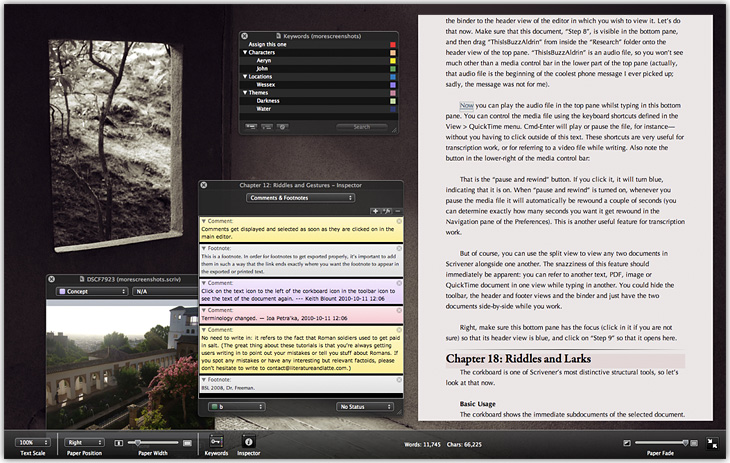
What I love most about Scrivener is that all of that information—your outline, corkboard, photos, character sketches, links to websites, research, and more—is contained within your manuscript folder. No joke. With one click you can move from the sentence you were writing to an image you want to reference (which you can also view in a pop-out window as you’re writing).

Clicking the back button will take you to the last page you were on, whether that’s your story, research, or something else. Each segment of your manuscript features a menu on the righthand side, which allows you to leave yourself notes, take a “photo” of a section before you change it (you know, just in case), and reference documents, images, or web pages so you don’t have to search later.


3. Break up the manuscript into more manageable segments. Have you ever wanted to jump back or ahead to a certain scene while writing or editing in Word? You end up scrolling forever, trying to remember which chapter the scene appeared in and then trying to find the chapter. With Scrivener, you can break up your story into smaller sections for easing jumping around.

I separate mine into three acts, then further divide the story into sections made up of a chapter each. Some people like to break the story up further, separating it by scene. It doesn’t really matter how you break it up, just that you no longer need to deal with one big chunk of text. (Don’t worry, when you compile the manuscript it all appears as one long story.)

The other great thing about this is that you can use the corkboard function to describe what happens in each act, chapter, scene, and so on. That way, when you want to review the chapter where the villain poisons the hero’s father, you can browse a corkboard of notecards and easily jump to the chapter you’re looking for.

This also makes chapter reorganization simpler. Let’s say you decide chapter twelve works better as chapter two. Instead of copying and pasting the whole chunk of text, you can move the folder or file containing chapter twelve to the spot right after chapter one. You can do the same for scenes if you break up your manuscript even further.

When it comes to editing, the ability to split the screen either horizontally or vertically makes it easy to view two sections of text without jumping back and forth through a document.


4. Outline more easily. Scrivener caters to outliners of all sorts. First, there’s the corkboard, which lets you outline on notecards that you can move around as you would paper cards. For each card, you can note details like the characters involved, the date the scene takes place, the act number, labels like whether it’s a chapter or scene, and draft number.

There’s also outline mode, which takes on the form of a traditional outline and can include the act number, characters involved, the date the scene takes place on, word count, and other stats.


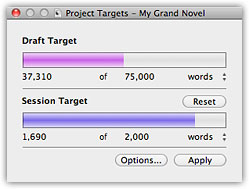
5. Keep track of every detail. The program will track stats for a given project, including word count and pages, based on a paperback book. If you plug in your word count goal, it’ll tell you how much progress you made at the end of a writing session. Set a target deadline and it’ll tell you how many words you need to meet each time you write in order to hit your word count and deadline goals.


6. Block out the rest of the world. (That means, you, Twitter.) With full-screen mode you can block out the rest of your screen—I’m talking the whole thing—so you only see your manuscript. It’s like Scrivener is slapping you upside the head and telling you to get to work.

I could go on, guys, but I fear I’m going to start sounding like the Scrivener Owner’s Manual so I’ll stop at six. There are a few more things you should know, which don’t require much explanation:
  • There’s a script-writing function.
  • You can import documents into Scrivener so you don’t have to start a new project from scratch.
  • There’s a name generator.
  • Click onto revision mode and automatically write in colored text based on the draft number (first draft, second draft, and so on).
  • Scrivener automatically backs up your data when you close the program.

SO.

After all that, enter the giveaway if Scrivener sounds like something you’d use.

Anyone else use it? Leave a comment with your favorite features for inquiring minds. 

All images are from Scrivener.

Friday, September 23, 2011

The Likability Factor


Let’s get one thing out of the way: I’m addicted to Dexter.

I thought you should know that because a) it’s an awesome show and b) it’ll help you understand where I’m coming from with this post. I wanted to talk about likable and unlikable characters. And who better to illustrate that with than a serial killer, right?

I’ll just say it … I love Dexter. Not just the show, but the guy. Sure, he kills someone almost every episode. Sure, he does it by hacking them to pieces. And, yeah, he has no remorse. But it’s hard not to love the guy.

The writers on the show really got the whole “make your character likable” thing, an especially hard task when he’s doing something as unpleasant as murdering people. So even if your character doesn’t get warm and fuzzy when he thinks about taking a saw to some stranger’s neck,* there’s something you can learn from Dex. (Yeah, I like to think we’re on a nickname basis by now.)

So, here are some things I’ve learned about creating likable characters from Dexter:


Give him a heart
Dexter may tell us that he’s heartless and incapable of emotion, but he’s only kidding himself. That’s because his actions—the way he cares for Rita and his children, the way he protects his sister—show us that he’s not empty inside. He may tell us he can’t love, but we see the way he loves them. And that makes us love him even more.

Add humor
For a crime drama, Dexter has an awful lot of laugh-out-loud moments. Because Dexter’s a bit, um, off, his comments about the people around him and the world in general are hysterical. His unique outlook on his surrounding, friends and family are funny to those of us who aren’t psychologically damaged. Don’t be afraid to let your character use his view of the world to make us laugh. We’ll like them better, even if they’re about to beat up a nerd or spill red Gatorade on the new girl’s white shirt.


Give him a hobby
Okay, I’ll admit Dexter’s hobby is a bit … unsavory. But, really, his attention to detail as both a forensic specialist and serial killer is admirable. He’s the best at what he does in both fields. Sure, we don’t exactly want to pat him on the back for being such an awesome serial killer, but you have to admit: A character who has a passion, follows it, and works hard at perfecting it is commendable.

Make us agree
The major reason everyone who watches Dexter loves him is that he’s doing a job that, deep down, we all want him to do. We see the other serial killers brutally murder innocent people and even though we know it’s wrong, we can’t help thinking, Dexter, please take care of this guy so Miami can be safe again. And, well, when the latest serial killer’s on the chopping block, it’s hard not to think that in a tiny way Dex is doing some good. Find some way we can identify with your character and we’ll love him, too. Give him a cause we believe in, one that we’ll get behind despite actions we don’t agree with.


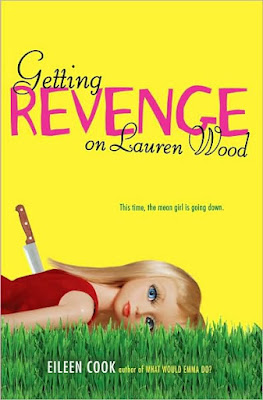
Speaking of likability, a few months ago I read GettingRevenge on Lauren Wood, which is about a girl, Helen, who returns to her old high school to destroy the girl who publicly humiliated her in middle school. This book walked the fine line between a likeble protagonist who we could identify with and one who we wanted to slap silly.

Truthfully, I think it hit the right balance, especially thanks to the humor. Still, I did have the nagging urge to push Helen down steep hill at some points. (Does that make me as bad as Helen, who would like to push Lauren Wood out of a speeding dump truck? Don’t answer that.)

What about you guys? Have you read anything with an unlikable character that was particularly well done? What made you like the character?

Also, a giant CONGRATULATIONS!!!!!!! to writers Katherine Owens and Lydia Kang, who both announced on Wednesday that they’ve found agents. You ladies rock!

*Too graphic? Sorry to the squeamish.

 Also, I think I've hit an all-time high for the number of knives in one post...

Wednesday, June 8, 2011

RTW: Plotter Versus Pantster

Road Trip Wednesday is a blog carnival, where YA Highway’s contributors and readers post a weekly writing- or reading-related question and answer it on our own blogs. You can hop from destination to destination and get everybody’s take on the topic.

This week’s prompt was: Are you a plotter or a pantser?

I suppose I’m a mix of both. Does that make me a plotser? A pantter? Some other mash up of the two words? I don’t know.

Here’s how I work, in a nutshell: As I’m brainstorming my idea, I’ll take notes in a file of possible complications and reactions, scenes, characters, character traits, and so on. Before I start writing, I have the basic storyline in my mind. (Remember how I told you I view it like a movie in my head? I can’t write until I can daydream a few scenes from the story. I won’t deny it if you call me insane.) I need to know the beginning, the end, and at least five key scenes along the way. After that, it’s pantsing all the way.

But change is afoot. My next idea is too complicated to write like that, so I’m taking the plunge and outlining it. At first I was intimidated, but now I have a great routine. First, I stare at the computer.

Then I stare more.

And then keep staring.

Oh, and when I’m done with that, I shrug it off for another day. If anyone has a more, um, productive method, I’d be happy to hear it.

I’ll be honest: I much prefer to come up with scenes as I’m writing. Still, outlining can organize thoughts, which is what I majorly need right now. I’m hoping that some time before 2015 I’ll have it done. If I’m not finished by then, send supplies. Food is preferred.

Are you a plotter or a pantster—or a mutt?

Also. I’m inching toward 250 blog followers, and you know what happens when I hit 250: An awesome blog contest! But wait, there’s more! I hit 300 followers on Twitter. Since I promised to up the ante should I meet the Twitter goal before the blog goal, it’s now turned into CONTEST OF AWESOME SQUARED. I’ll announce the prizes when number 250 signs up. 

Friday, June 3, 2011

8 Tips for Better Self-Editing


Since I’ve been wading in the Sea of Revisions, I thought I’d share some of my editing tips. We all edit differently and I always find it interesting to hear how others do it. I thought you might, too. (Don’t tell me if I’m wrong.)

1. Read the manuscript aloud. I’m sure you’ve heard this one before, but for me it’s critical. That’s how I determine if the rhythm of the sentences or paragraphs is off. It’s also how I catch stupid typos when Microsoft Word lets me down. (I mean, are and our aren’t replaceable—even if they’re both spelled correctly.)

2. Take time away. Like a good rebound relationship, revisions work best after you’ve taken some time away from the game. There’s a 500 percent chance that a couple weeks or more away from your manuscript will make you a better editor. Also, that comprehensive critique will seem a lot less critical and much more helpful after you’ve digested everything.

3. Highlight all of the verbs. This will be tedious. I promise. But your work will be stronger for it. Take out that pretty yellow highlighter and mark up each and every verb. When you go back and review the highlights, look for any weak verbs and replace with stronger ones. Also check for verb-adverb constructions and change them to stronger verbs.

4. Circle all metaphors and similes. Check to make sure you’re using the correct metaphor or simile for your character. A character who spends his summers mowing laws would probably describe freshly mowed grass differently than someone who grew up in the city.

5. Cut any scene that isn’t furthering the plot, character arc or, better yet, both. You can preserve the BEST WRITING YOU’VE EVER DONE by copying and pasting it into a new document. Tell yourself you’ll add it back. Then read the scenes and pat yourself on the back for how much better the story sounds.

6. Make a pass for every character. Listen, each character should act as if they’re the main character of the story. Because to them, they are. In a story about me, the mechanic who works on my car is a side character. But I’m a side character in his story, too. Everyone is the main character of their own story.

7. Check for character voice. Paste a chunk of dialog into a new document. Remove the dialog tags. Can you tell the difference between characters from the dialog? Everyone speaks differently, and so should your characters. Make sure yours don’t all sound like the narrator.

8. Do a pass for first and lasts. Make sure the beginning and end of each chapter and scene stand out. These can get overlooked, but they should be handled with just as much care as you do the first and last line of the book.

That’s all for now. What are your self-editing tips?

Monday, May 30, 2011

There's a Brainstorm Brewing

I’m so glad you liked the query I crafted for the story you guys came up with. I had fun, so I might make the What If game and query a monthly feature. I’m wild and crazy like that.

I made a boatload of progress on the pages I’m revising rewriting, but I allowed myself some time to just sit and think about this new idea that’s been bugging me. I’m not sure how everyone else brainstorms (I have this feeling it’s intense and structured and I’m a giant dork for not knowing the trick just yet) but I thought I’d share what works for me.

For starters, I don’t need to have a strict outline when I start writing, but I at least like to know where I’m starting, the main conflict and characters, a few key scenes, and the end.

I’m really visual, and when I’m writing it’s as if the story’s playing out like a movie. Before I even start a new project, I find some music that captures the tone I want the story to have. Once I have a good playlist, I lie down with headphones in. And I watch the story unfold.

Sometimes I do this for a single scene I’m stuck on, but at the start of a project it’s all open and free. I’ll think about certain scenes and watch the characters interact and see where they go from there.

It’s easier for me to think about what might happen next or what obstacles I might throw at my characters when I’m watching this “movie” behind my eyes. Somehow, staring at a blank document, my brain stops buzzing with thoughts and ideas. 

Actually, I take that back. It’s still buzzing with thoughts, but none of them have anything to do with the story. Usually they’re like, “I could use another glass of water” or “I need to file my nails.”

How do you brainstorm a new story idea?

Monday, May 2, 2011

Trust Yourself


Speaking of revisions

So I’m revising my WIP, which has been a lesson in inconsistency. The first day I touched it, I edited chapters one through four. I hit chapter ten before I took some time off to move and unpack.

When I returned, my WIP had become this huge, insurmountable task. In my spare moments I’d open it, remember how much work I had to do, and shut it again.

(Note: This is not a useful process if the goal is to finish revisions some time before the 2012 Apocalypse.*)

I’d revise on weekends when I had a full day to think about just how awful my story was. And then I’d finish a section and decide this was going to be worse than crap. I’d dive into a book to relax, which would only leave me thinking that there was, in fact, no way I could turn my story into something even remotely as good as the book I just read.**

I’d been a while since I opened the document—maybe a week and a half—when I started revising on Saturday afternoon. By Sunday night, when I finished, I had revised one chapter and rewritten five.

Also, my shoulders hurt.

A complete lack of faith in my ability as a writer and storyteller was behind my hesitation to jump in. Because when I re-read those chapters, they were good. Not perfect, of course, but good. What I thought I’d never figure out, I did. And it works in the story.

We all revise differently, but here’s what I took away from my weekend of marathon revisions:

1.     Find a computer.
2.     Pull up a chair.
3.     Open your manuscript.
4.     It’s not that bad.
5.     You’re going to make it better.
6.     Stop your whining.
7.     Write.

No matter how much the blank page or revision notes make you want to quit and take up coal mining, you will figure it out. So stop stalling. Open and write.
 

*Or the zombie Apocalypse. Whichever comes first.
**Curse you John Green and Melina Marchetta!

Friday, April 8, 2011

The Revision Freak Out


I’m in the middle of revising my YA sci-fi novel, which means sometimes I look like this:


Like when I re-read a passage and I actually love it. Or when I’m sucked in to my own story. But most of the time I look like this:


Usually I stare at my revision to-do list and have a minor freak out because the draft sucks and I’m not sure I’m capable of reworking it the way it needs to be reworked. You know when you stare at the last five chapters and think they’d be better off in the trash? Yeah, I’m there.*

And it’s not that the words themselves bother me. It’s the fact that those words in those paragraphs and in those scenes don’t quite belong in that order. Sigh.

So I’ve been working through my revision notes methodically, attempting to ignore the crazy amount of yellow comments in future chapters. It’s kind of like ignoring an itch when someone tells you their house has bedbugs. Which is to say, almost impossible.

But because I’m not overwhelmed enough, I decided to follow all of the tips Donald Maass tweeted last month. And of course they’re all awesome. And of course following them will make my manuscript better to the Maass degree.

I won’t list them all here since I’m guessing most of you have seen them, but I wanted to point to a few that have inspired changes in my story so far.
#14 In your climactic scene, what are 3 details of place that only your MC would notice? Cut more obvious details, replace with these.

#18 Give your MC passionate feelings about something trivial: e.g., cappuccino, bowling, argyle socks. Write his/her rant. Add it.

#26 Whom is your MC afraid to let down? What is the sacred trust between them? What would cause your MC to break it? Break it.

#30 What’s the worst thing that happens to your MC? Work backwards. Make it something your MC has spent a lifetime avoiding.
How do you revise? Do you have any tips to add to these?

Also, a huge congrats to my friend Erin Bowman who just sold her YA trilogy! You can read the Publishers Marketplace blurb on her blog. (Sneak peek: It sounds amazing.)

*Please tell me I’m not the only one who feels this way...

Friday, March 25, 2011

My, What Big Eyes You Have


After a week of dating The Man, I moved home to Massachusetts. (Well, technically I spent a month in Europe post-college graduation and then I moved back home.) He stayed in Baltimore, so we mainly spoke on the phone for four months.

One night, friends of our family came to dinner and asked about The Boy. I told them how I had a major crush on him for the entire year we worked together but he barely noticed me. I explained how, motivated by annoyance and my impending graduation, I told him I liked him—only to get shot down. And I told them how he came back begging (naturally) and wanted to date (of course).

And then my mother’s best friend asked me something.

“What color eyes does he have?” Um…

Mind you, I’d spent a year (covertly) staring at him and working side-by-side with him and attempting to make witty jokes so he’d pay attention to me and not the TV when the restaurant was dead. I’d spent every day for a week with him. I knew he had great eyebrows (yeah, I was jealous) and a slight Baltimorean twang. But his eyes?

“Brown,” I said as if I knew. Only I didn’t. I had no idea what color his eyes were. But his hair was brown and, hey, most brunettes also have brown eyes. Besides, brown eyes were more common than blue.

Of course, the first time he came to visit, the first thing I looked at were his eyes. His blue eyes. Bright blue eyes.

My point here is that if I didn’t notice the eye color of the person I spent most of my days thinking about, how could I ever remember the eye color of my teacher, my boss, the bank teller. Unless you look like these guys...


...I probably have no idea what your eyes look like.

And yet every main character that’s ever lived makes a mental note of everyone’s eyes. Even if the person isn’t important to the main character. Even if the person’s standing across the room.

(Dudes, there’s no way I could tell someone’s eye color the minute they walk in the door. Or in the middle of a fight. Or when I’m paying attention to anything else around me.)

I’d also like to point out how incredibly close to someone you need to be in order to notice the nuances of the eyes. If you are noticing the flecks of jade in the new kid’s eyes, you’re probably thisclose to making out. Not four desks over.

(Also, why do characters notice flecks or deep tones in the eyes and not a weird vein or popped blood vessel?)

I’m not saying you don’t have to mention eye color in your book, but consider the situation. Ask yourself whether you would notice that person’s eyes or at that time or from that distance.

Quick (without looking, you cheater, you) what color eyes does Katie Holmes have?